2 Aldermanbury Square
View all projectsCarbon neutral in the City
2 Aldermanbury Square is one of the most historically sensitive addresses in the City of London; adjacent to the Guildhall and surrounded by a concentration of designated heritage assets the site demands an approach to design that balances architectural ambition with a careful contextual response. Driven by a sustainability agenda, this new BREEAM Outstanding building delivers flexible workspace across 13 storeys of generous floor plates, high-quality tenant amenity, and a considered relationship with the street and adjacent public spaces.
Context
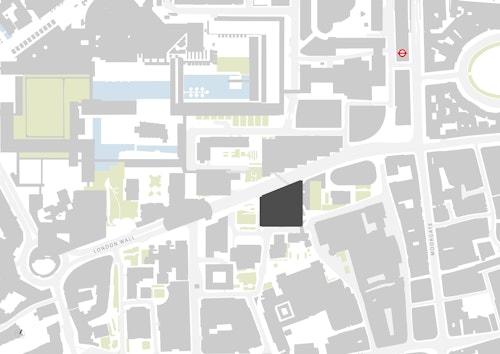
2 Aldermanbury Square replaces City Place House, a building designed in the 1980’s whose environmental performance, general arrangement and aesthetic no longer met contemporary workplace expectations. It was also a building that was disengaged from its physical environment with an opaque facade dominated by back of house functions.
The new building doubles the amount of floor area previously on the site, better engages with the street and adjacent public spaces, and improves pedestrian experience.
Context
Challenge
The project presented a convergence of challenges: a constrained urban site, a requirement for best-in-class commercial accommodation, a complex environment for servicing, and an ambition to achieve meaningful sustainability targets within a heritage context. Our response was to treat these constraints as drivers for a more rigorous and inventive design process.

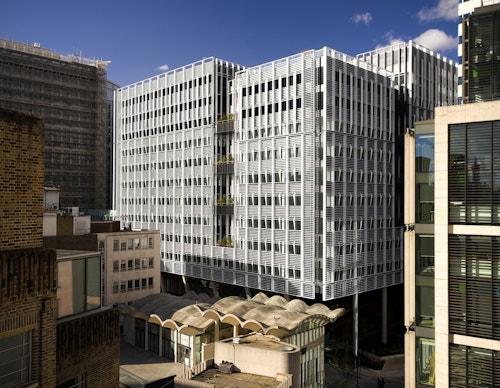
The height and massing are restricted by sensitive LVMF views and Guildhall local views. The total number of floors is fixed at Ground + 12 floors.
2 Aldermanbury Square from the Guildhall
Concept
Our initial response explored the reuse of the existing structure, and extending the building to deliver the desired increase in area. However, detailed whole-life carbon analysis demonstrated that a new-build solution would deliver a better result per sqm when combining embodied carbon with superior environmental performance, enhanced spatial quality, flexibility, and long-term asset value. This evidence-led decision-making process, anchored in carbon and cost appraisals, was critical in aligning sustainability ambitions with commercial outcomes.
The resulting scheme doubles the floor area of the original building. A modest increase in height was calibrated to respect a protected view corridor from the dome of St Paul’s Cathedral and surrounding townscape views that protect the setting of the Guildhall.
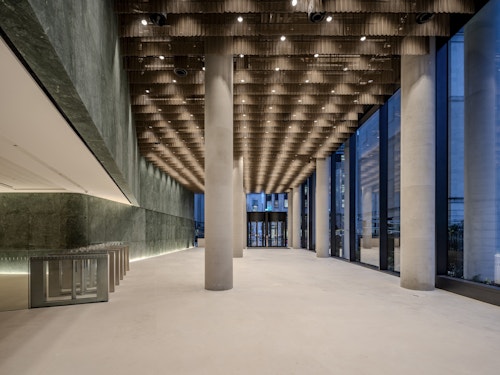
On the ground floor a generous double height reception and welcoming lobby space include a feature staircase which connects end of trip facilities in the basement with a lounge on the first floor. A panoramic roof terrace commands views of the City while inset balconies punctuate the overall building massing and provide additional amenity. The whole is clad in a striped veil of white metal cladding that manages solar shading and light-spill without restricting views; the high gloss finish reflecting the changing colour of the sky.
1/3
The lobby under construction

2/3
End-of-trip facilities in the basement

3/3
Cycle store
Process
A project-wide carbon budget was established at the outset of the design process, informing decisions on everything from structure, to envelope, and services, to landscaping and public art. A key strategy was the retention and reuse of existing groundworks, removing the need for excavation and the associated embodied carbon of new pile foundations. City Place House’s steel frame was deconstructed, with over 1,500 tonnes ‘harvested’ to provide almost 80% of the steel frame on another GPE project.
In parallel, we published a client-led research initiative exploring the use of BIM to unlock the material commodity value of buildings like 2 Aldermanbury Square. The project’s Material Passport Platform provides a framework for future adaptability and the reuse of materials, embedding long term resource efficiency into the building’s lifecycle.
Operational performance was addressed with equal rigour. The facade design incorporates solid cladding below desk height to reduce solar gain and cooling loads, improving energy efficiency while maintaining high levels of daylight and occupant comfort. The veil is designed to a carefully calibrated depth of 400mm, while the ‘petal’ detail widens as it rises up the building; together these details provide the necessary shading. In London’s warmer summers this will provide welcome relief for office workers.
The final building exceeded the 572kgCO₂e/m² project target, a carbon footprint below the threshold set by the Net Zero Carbon Building Standard, as well as achieving BREEAM Outstanding and NABERS Design for Performance 5-star ratings. 2 Aldermanbury Square is one of the most environmentally progressive office buildings delivered in the City of London to date.

Facade detail
1/3
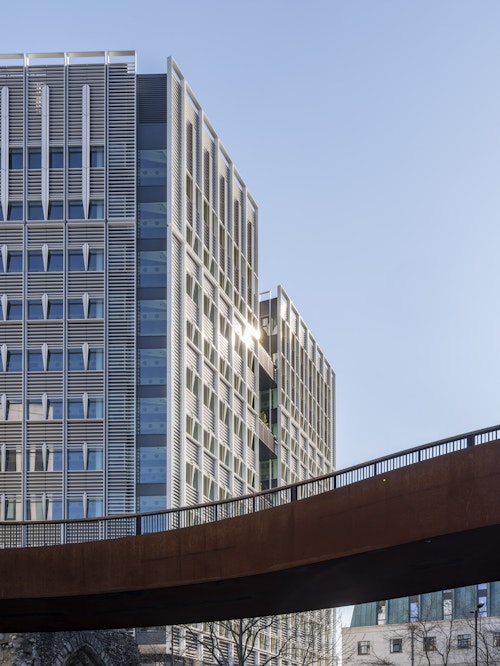
New public realm links to the City's network of elevated walkways

2/3
The new pedestrian bridge

3/3
Seen from Elsyng Spital Church Tower opposite
Impact
A central ambition was to reconnect the building with the historic public realm. The design introduces a series of carefully integrated public realm interventions that enhance permeability, legibility, and amenity.
On London Wall, angled columns hold the workspace floorplates 11.4m above street level allowing the pavements to be substantially widened improving pedestrian movement and dwell time. A new pedestrian route linking London Wall and Basinghall Street strengthens connections through the site and introduces new planting and spaces to sit - a moment of relief within the dense urban fabric - while enhancements to the elevated walkway network re-engage with the City’s layered circulation system and link through to the Barbican.
A significantly rationalised building servicing strategy allows the ground plane to be prioritised for people rather than vehicles. This integration of servicing, public realm, and architecture is fundamental to unlocking the site’s full potential.
Throughout the design and delivery process, we engaged closely with prospective tenants, testing bespoke requirements and accommodating potential modifications. The scheme was fully pre-let during construction to Clifford Chance as their new global headquarters, confirming the building’s status as a super prime lettable office.

Basinghall Walk
Level One
